Wednesday, June 5, 2013

Why does a compass needle get deflected when brought near a bar magnet

Q. No 1: Why does a compass needle get deflected when brought near a bar magnet?

Ans: The needle of a compass is a small magnet. That’s why when a compass needle is brought near a bar magnet, its magnetic field lines interact with that of the bar magnet. Hence, a compass needle gets deflected.

Does Euclid’s fifth postulate imply the existence of parallel lines? Explain

1.     Does Euclid’s fifth postulate imply the existence of parallel lines? Explain
 According to Euclid's fifth postulate If a straight line falling on two straight lines makes the interior angles on the same side of it taken together less than two right angles, then the two straight lines, if produced indefinitely, meet on that side on which the sum of angles is less than two right angles.
For example

 he line PQ in Fig. 5.6 falls on lines AB and CD such that the sum of the interior angles 1 and 2 is equal to 180° on the left side of PQ. Therefore, the lines AB and CD will eventually intersect on the left side of PQ.
Euclid’s fifth postulate

How would you rewrite Euclid’s fifth postulate so that it would be easier to understand

1.How would you rewrite Euclid’s fifth postulate so that it would be easier to understand?

Solution.
There are several easy equivalent versions of Euclid's fifth postulate.
Two lines are said to be parallel if they are equidistant from one other and they do not have any point of intersection.

Then, by Play fair’s axiom (equivalent to the fifth postulate), there is a unique line m through P which is parallel to l.

Why is Axiom 5, in the list of Euclid’s axioms, considered a ‘universal truth’?


7. Why is Axiom 5, in the list of Euclid’s axioms, considered a ‘universal truth’? (Note that the question is not about the fifth postulate.)

Euclid's Axiom 5 states that "The whole is greater than the part. Since this is true for anything in any part of the world. So, this is a universal truth.

if AC = BD, then prove that AB = CD

6. In Fig. 5.10, if AC = BD, then prove that AB = CD.

From the above figure  we get that
AC     = AB + BC
BD     = BC + CD
It is given that AC = BD

Plug the value of AC we get
AB + BC      = BC + CD            … (1)
According to Euclid’s axiom,when equals are subtracted from equals, the remainders
are also equal.
Subtracting BC from both side in equation (1), we get
AB + BC BC       = BC + CD BC
AB     = CD
Hence proved


point C is called a mid-point of line segment AB. Prove that every line segment has one and only one mid-point

5. In Question 4, point C is called a mid-point of line segment AB. Prove that every line segment has one and only one mid-point.
Let C and D are two midpoints of the line segments AB
According to Euclid’s axioms 4
AC     = BC           ...(1)
D is also a mid point so that
AD     = DB           … (2)
We have                AB     = AB            … (3)
And  we know       AB     = AC + CB  
AB     = AD + DB
From equation (iii)
AC + CB      = AD + DB
From equation (1) and (2)plug the value of BC and DB we get
AC +AC       = AD +AD
2AC   = 2AD
Divide by 2 we get
AC     = AD
Both points are on same line so both points will superimpose and D and C are exactly at the same place

Hence midpoint of the lines segment is always unique 

If a point C lies between two points A and B such that AC = BC, then prove that AC =1/2AB. Explain by drawing the figure.

4. If a point C lies between two points A and B such that AC = BC, then prove that
AC =1/2AB. Explain by drawing the figure.
Solution

Given that C is the lies between both points A and B
And
AC     = BC
Add AC both side we get
AC  + AC     = BC + AC

According to definition of Euclid , if equals are added to equals, whole will equal 
Here, (BC + AC) coincides with AB. It is known that things which coincide with one another are equal to one another.
2AC  = AB 
Divide by 2 we get

AC     = AB/2 

Consider two ‘postulates’ given below: (i) Given any two distinct points A and B, there exists a third point C which is in between A and B. (ii) There exist at least three points that are not on the same line. Do these postulates contain any undefined terms? Are these postulates consistent? Do they follow from Euclid’s postulates? Explain.

3. Consider two ‘postulates’ given below:
(i) Given any two distinct points A and B, there exists a third point C which is in between A and B.
(ii) There exist at least three points that are not on the same line.
Do these postulates contain any undefined terms? Are these postulates consistent?
Do they follow from Euclid’s postulates? Explain.

Solutions :-
There are several undefined terms in the given postulates.
The given postulates are consistent because they refer to two different situations.
In first postulate two points A and B are given points then there will point C lying in the line between them 

Postulate (ii) states that for the given points A and B we can take point C not lying on the lines 

These postulates do not follow from Euclid’s postulates.  However they follow from the axiom, given two distinct points, there is a unique line that passes through them”.

Give a definition for each of the following terms. Are there other terms that need to be defined first? What are they, and how might you define them? (i) parallel lines (ii) perpendicular lines (iii) line segment (iv) radius of a circle (v) square

2. Give a definition for each of the following terms. Are there other terms that need to be defined first? What are they, and how might you define them?
(i) parallel lines                     (ii) perpendicular lines        (iii) line segment
(iv) radius of a circle            (v) square
Solution.
(i) parallel lines
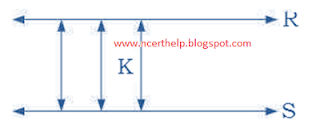
(1) Parallel straight lines are straight lines which, being in the same plane and being produced indefinitely in both directions.
(2) Perpendicular distance between two lines is always constant
(3) Parallel lines do not meet one another in either direction.
(4) These lines never intersect each other.
(5) in below figure R and S are parallel lines and  K is the perpendicular distance
 parallel lines
 parallel lines

(ii) Perpendicular lines
These lines always intersect one another at right angle (90 degree)
In below figure P and Q are perpendicular line
Perpendicular lines
Perpendicular lines

(iii) Line segment.
A straight line drawn from any point to any other point is called as line segment.
A line segment which extends indefinitely in both directions gives a line.

Line segment
Line segment

Here PQ is a line segment 

(iv) Radius of a circle.
 A line segment joining the centre to any point on the circle is called the radius of the circle. It is the distance between the center of a circle to any point lying on the circle.
Radius of a circle
Radius of a circle

 (v) Square.
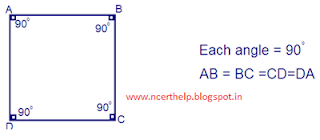
A square is that which is both equilateral and right-angled. That means all sides are equal and each angle is 90 degree. 
Square
Square

Magnetic Effects of Electric Current science 10

S.No.

Magnetic Effects of Electric Current

Intext Question page 224
1 Why does a compass needle get deflected when brought near a bar magnet?
Intext Question page 228
1 Draw magnetic field lines around a bar magnet.
2 List the properties of magnetic lines of force.
3 Why don’t two magnetic lines of force intersect each other?
Intext Question page 229
1 Consider a circular loop of wire lying inthe plane of the table. Let the currentpass through the loop clockwise. Applythe right-hand rule to find out thedirection of the magnetic field insideand outside the loop. 
2 The magnetic field in a given region isuniform. Draw a diagram to represent it. 
3 Choose the correct option.The magnetic field inside a long straight solenoid-carrying current(a) is zero.(b) decreases as we move towards its end.(c) increases as we move towards its end.(d) is the same at all points. 
Intext Question page 231
1 Which of the following property of a proton can change while it movesfreely in a magnetic field? (There may be more than one correct answer.)(a) mass (b) speed(c) velocity (d) momentum 
2 In Activity 13.7, how do we think the displacement of rod AB will beaffected if (i) current in rod AB is increased; (ii) a stronger horse-shoemagnet is used; and (iii) length of the rod AB is increased? 
3 A positively-charged particle (alpha-particle) projected towards west isdeflected towards north by a magnetic field. The direction of magneticfield is(a) towards south (b) towards east(c) downward (d) upward 
Intext Question page 233
1 State Fleming’s left-hand rule.
2 What is the principle of an electric motor?
3 What is the role of the split ring in an electric motor?
Intext Question page 236
1 Explain different ways to induce current in a coil.
Intext Question page 237
1 State the principle of an electric generator.
2 Name some sources of direct current.
3 Which sources produce alternating current?
4 Choose the correct option.A rectangular coil of copper wires is rotated in a magnetic field. Thedirection of the induced current changes once in each(a) two revolutions (b) one revolution(c) half revolution (d) one-fourth revolution 
Intext Question page 238
1 Name two safety measures commonly used in electric circuits andappliances 
2 An electric oven of 2 kW power rating is operated in a domestic electriccircuit (220 V) that has a current rating of 5 A. What result do youexpect? Explain. 
3 What precaution should be taken to avoid the overloading of domesticelectric circuits? 
Exercise Questions
1 Which of the following correctly describes the magnetic field near a long straight wire? (a) The field consists of straight lines perpendicular to the wire. (b) The field consists of straight lines parallel to the wire. (c) The field consists of radial lines originating from the wire. (d) The field consists of concentric circles centred on the wire. 
2 The phenomenon of electromagnetic induction is (a) the process of charging a body. (b) the process of generating magnetic field due to a current passing through a coil. (c) producing induced current in a coil due to relative motion between a magnet and the coil. 
3 The device used for producing electric current is called a (a) generator. (b) galvanometer. (c) ammeter. (d) motor. 
4 The essential difference between an AC generator and a DC generator is that (a) AC generator has an electromagnet while a DC generator has permanent magnet. (b) DC generator will generate a higher voltage. (c) AC generator will generate a higher voltage. (d) AC generator has slip rings while the DC generator has a commutator. 
5 At the time of short circuit, the current in the circuit (a) reduces substantially. (b) does not change. (c) increases heavily. (d) vary continuously. 
6 State whether the following statements are true or false. (a) An electric motor converts mechanical energy into electrical energy. (b) An electric generator works on the principle of electromagnetic induction. (c) The field at the centre of a long circular coil carrying current will be parallel straight lines. (d) A wire with a green insulation is usually the live wire of an electric supply. 
7 List three sources of magnetic fields.
8 How does a solenoid behave like a magnet? Can you determine the north and south poles of a current–carrying solenoid with the help of a bar magnet? Explain. 
9 When is the force experienced by a current–carrying conductor placed in a magnetic field largest? 
10 Imagine that you are sitting in a chamber with your back to one wall. An electron beam, moving horizontally from back wall towards the front wall, is deflected by a strong magnetic field to your right side. What is the direction of magnetic field? 
11 Draw a labelled diagram of an electric motor. Explain its principle and working. What is the function of a split ring in an electric motor? 
12 Name some devices in which electric motors are used.
13 A coil of insulated copper wire is connected to a galvanometer. What will happen ifa bar magnet is (i) pushed into the coil, (ii) withdrawn from inside the coil, (iii) heldstationary inside the coil? 
14 Two circular coils A and B are placed closed to each other. If the current in the coil A is changed, will some current be induced in the coil B? Give reason. 
15 State the rule to determine the direction of a (i) magnetic field produced around a straight conductor-carrying current, (ii) force experienced by a current-carrying straight conductor placed in a magnetic field which is perpendicular to it, and (iii) current induced in a coil due to its rotation in a magnetic field. 
16 Explain the underlying principle and working of an electric generator by drawing a labelled diagram. What is the function of brushes? 
17 When does an electric short circuit occur?
18 What is the function of an earth wire? Why is it necessary to earth metallic appliances?